Metaverse Sailing

November PHRF Update

November 20, 2009 · Leave a Comment

PHRF  handicaps
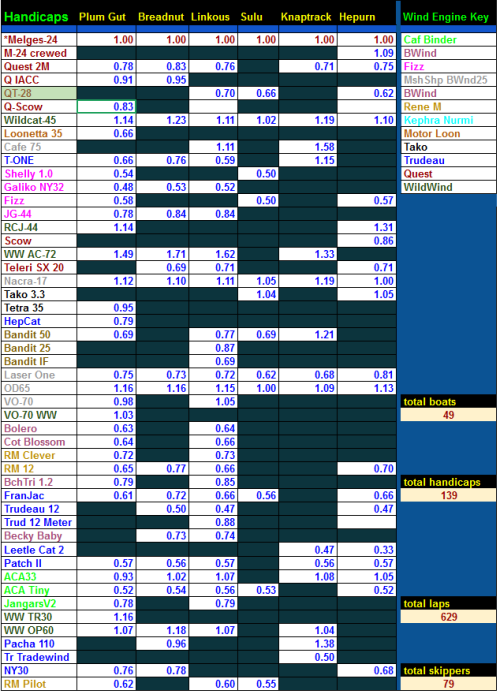
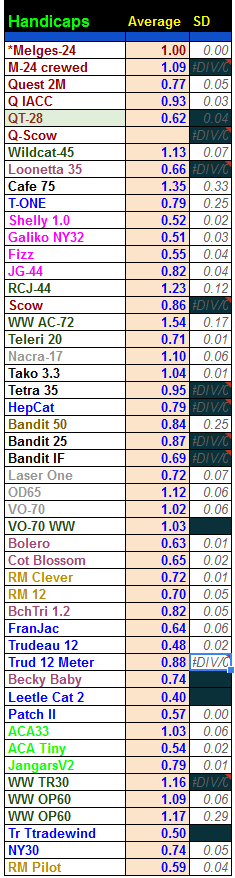
Here’s a quick update of the  PHRF Handicaps, including new boats and stronger numbers. “Handicap Hotlaps” is a fun way to test your skill against other sailors on a short, test-track solo race course. If sailors think they ran an ‘average, good lap’ on the PHRF course in current use, they can save their scores in a database for future reference, and that data will also be used to set ‘performance handicaps’ for different sailboats in SL. The laps are fun, quick and build sailing skills… and after two years of databasing the results, I admit the finding are also pretty interesting.

I posted a summary of PHRF handicap results a few months ago. Since then, many sailors have continued to add laps and try out new boats using the Madaket web-liked PHRF database that is the current PHRF test track. I’m still going through all that information and doublechecking it with boatwrights and beta-testers, but at the request of several sailors let me give you a quick snapshot of a few new boat scores and adjusted handicaps. My hope is to update the  summary handicap information here at least once a month from now on, since the J-CLASSIC Regatta that was taking all my time is now safely tucked away in hiberation!

First off: Let me give another huge thanks to Cynthia Centaur and Francois Jacques for all their assistance developing and expanding the ”PHRF Handicap” idea, and helping set up the current test line in Madaket. Oliphant Ming and Chaos Mandelbrot were also invaluable problem solving issues and discussing features.

But let me give the biggest woot out to all the skippers who ran laps and contributed their scores!

Gemma Vuckovic, Francois Jacques, Carmen Foden, joro Aya, Garrick Diesel, Justbent Clarity, Heidi Stiglitz, Angus Moonwall, Dunan Wilder, Chaos Mandelbrot, Cory Copeland, LDeWell Hawker, Oliphant Ming, Julia Ceres, Liv Leigh, Triton Sands, Hal Burnstein, Blackbird Latte, Argus Farman, Vin Mariani, Rodman Mapholisto, Alain Gloster, Jane Fossett, nobuko Criss, Allie Tomsen, Angus Moonwall, Bunnie Mills, CS Price, Emme Eales, Jehan Jameson, Liv Leigh, Naeve Rossini, Nomad Zamani, Reven Fhang, Quirky Torok, Isis Rexie, Everest Piek, Arrekusu Muromachi and Masahisa Greenwood, Herris Merlin, disisme Misfit, Armano Xaris, Charlz Price, Deserted Rhode, Axle Wharton, Dutch Hoorenbeck, Pensive Mission.

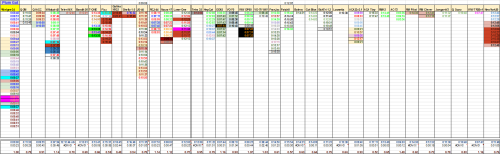
 Here’s the new table, but please note there are many new boats and laps, and this is only a partial update; I’ll add the rest soon. The table below follows the same format and conventions as  previous ones.

Since the last update a few months ago, sailors have  contributed lap data for several additional , popular boats.

ACA33v2.5 - The ACA32 was introduced in the Spring of 2007 as part of the ACA32-SL Cup and the “ACA-Anywhere” promotion; it quickly became a very popular boat.  The first major upgrade of that original design was the ACA33 in the summer of 2008.  Several revisions followed rather quickly to address different issues with the boat.   Based on nearly three dozen data laps submitted by many sailors in the first half of 2008, the ACA32 scored a handicap factor of 1.16. Since that time well over one hundred laps were submitted on different courses sailing the ACA33v2.0. the results proved virtually identical; the current ACA 33v2.0 score is 1.15. I understand that the ACA33v2.0’s wind engine was re-tuned by disisme Misfit this past Summer, and the Madaket lap data shows the resulting ACA33v2.5 is 13% faster, with a PHRF handicap score of 1.30. Thank you to Carmen Foden and Quirky Torok for their help sorting out the different version numbers.

JG-44 1.01- The JG-44 1.01 is designed by Juli Gothly who’s main store is in Sailor’s Cove: http://slurl.com/secondlife/Fishers%20Island/165/66/24 . Her boats are based on the Fizz 3 engine, and the JG-44 in particular has quickly become a very popular one-design racer. It’s showcased at several well-attended weekly regattas. The JG-44 scored a 0.88 in PHRF, based on a relatively small number of laps by Liv Leigh and Tim Warhol. Please don’t confuse it with the WildWind RCJ-44, however! the RCJ-44 has a much different performance response, and a PHRF= 1.35.

Beluga 1.01 -   The Beluga is another in Juli’s line, and so far it has a Madaket lap score of 0.62. We’ll see how those numbers hold up as more sailors contribute laps!

RSiX 1.2 – Surfwidow Beaumont’s fantastic windsurfer finally made the list, and the RSiX v1.2 scored the fastest laptimes ever recorded on the test track! It completed the course in a phenomenal 04:42, meriting a PHRF handicap of 2.50. That result soundly trouncing the past speed record holder, the TruCor BeachCat (PHRF= 1.62). Wowzers!  Surf has an RSiX 1.4 as well, but at the moment there are too few Madaket laps to say much about it yet. Instead, I’ll show you the video:

SCS Battleship- OK, I admit I know nothing about battleships. Well… thanks to Herris Merlin, maybe I now know one thing: Based on a small number of consistent laps, the SCS Battleship scored a 0.88. (but do people race battleships?)

 Lots O’ Links

There were many discussions of handicapping over the past couple years; I apologize if that long trail makes it confusing to some sailors.
To make it a bit easier, I collected many of the links from past posts on PHRF, so people could see what the thinking has been over time.
Here’s a partial list of those links:

Feb 11 2007 Handicapping
A post discussing handicap issues for the then-new “Big-Boat Races.”
http://slsailing.org/forum/viewtopic.php?p=2224#2224

Apr 5 2007: Handicapping sailors
A discussion of ‘Handicapping sailors’ not boats. The thread quickly turned into a discussion of whether Pensive Mission looked like a troll and secretly wanted to tie up Cory Copeland. Neither of the latter questions have been meaningfully discussed here since.
http://slsailing.org/forum/viewtopic.php?t=722

Nov 20 2007 Should big-boat races be split up?
Big boat racers decided the newly-released Larinda was significantly faster than the equally-matched Yawl and Defender II. How much faster? J Trudeau, helpful as ever, said she didn’t know and suggested sailors figure it out. I think this thread is the first place the basic ‘rules’ for PHRF Handicap Hotlaps are listed.
http://slsailing.org/forum/viewtopic.php?t=1524

Nov 25 2007: Deviant Hotlaps
A discussion of wind variation and its implications for valid, reliable lap time scores. It degenerates into a discussion of whether the sailors are the ‘deviant’ ones…
http://slsailing.org/forum/viewtopic.php?t=1550

Nov 26 2007: Trudeau Handicap Hotlaps
Nine pages of laps, data, discussion about performance handicapping.
http://slsailing.org/forum/viewtopic.php?t=1555&highlight=phrf++handicap%2A

JANUARY 3 2008: PHRF Hotlaps summary
http://slsailing.com/archives/180

Feb 3 2008: Adding It All Up
February 2008 update of lap data and handicap scores.
http://metaversesailing.wordpress.com/phrf/adding-it-all-up-february-3rd-2008/

Feb 6 2008 (and many updates): Handicap Hotlaps Results
This is a sticky thread with spreadsheets and summary tables for the different test courses and boats in 2008.
http://www.slsailing.org/forum/viewtopic.php?t=1837

FEBRUARY 11 2008: PHRF Summary
http://slsailing.com/archives/232

Jun-Oct 2008 PHRF Handicap Hotlaps
12 pages of discussion and data from last year
http://slsailing.org/forum/viewtopic.php?t=2246

AUG 7 2008: A New Handicap Hotlaps Course?
A short thread discussing issues with the past phrf test courses, and new ones are proposed and tried at NYC and FIYC.
http://slsailing.org/forum/viewtopic.php?t=2426

AUG 10 2008: FIYC Hotlaps
PHRF discussion and data on Epicurus Emmons’ FIYC course.
The results paralleled all the others.
http://slsailing.org/forum/viewtopic.php?t=2434

Mar 2009: PHRF Hotlaps 2009
Following the move to Blake Sea, Cynthia Centaur, Francois Jacques, and Jane Fossett set up the Madaket Hotlaps Course with a user-friendly web database system.
http://metaversesailing.wordpress.com/phrf/phrf-hotlaps-2009/

Apr 2009: Madaket wind setter out of date – why?
“Unhelpful whining.”
http://www.slsailing.org/forum/viewtopic.php?t=3148

Apr 14 2009: PHRF 2009 Madaket Hotlaps Discussion Thread
Discussion of the new Madaket web-based hotlaps system.
http://slsailing.org/forum/viewtopic.php?t=3159

June 2009: June PHRF Update
Summary of the Madaket data compared to 2008.
http://metaversesailing.wordpress.com/2009/06/02/june-phrf-update/

July 19 2009: PHRF Update, WildWind
More Madaket data, discussion of WildWind boats, concern different wind engines could yield less reliable comparisons.
http://metaversesailing.wordpress.com/2009/08/11/phrf-handicaps-wild-winds/

May-July 2009: RCJ-44 and JMO-60
Specific discussions of performance data for these boats:
http://metaversesailing.wordpress.com/2009/05/26/fast-forty-four/
http://metaversesailing.wordpress.com/2009/07/07/windwind-jmo-60-quick-look/

_________________

→ Leave a CommentCategories: PHRF

J-CLASSIC FINALS III: Rise of the Cetaceans

November 18, 2009 · Leave a Comment

When we last left off in this tale of the J-CLASSIC Finals, the NYC-Narwhal crew of Nomad Zamani, Chaos Mandelbrot, and Glorfindel Arrow was in a rather sorry state. It was Half-Time; four races were scheduled, and two were on the scoreboard, but those numbers did not look good for Narwhal. In the first two races, Waypoint All-Stars had repeatedly outmaneuvered NYC, and Eureka proved incredibly fast compared to NYC’s whale-boat entry.

However, the absolute worst thing of all for NYC was that their Ace Starting Pitcher, Nomad Zamani, had crashed-out twice in the last race. Narwhal had used-up it’s only discard in the  crash, so NYC was up now against the wall; Team NYC knew that one more bang-up  like that would be lethal, and surely mean an early end to their hubristic playoff hopes. Although back in the locker room, Nomad was still having connection problems and limping badly when Race Director Hay Ah sounded the horn to field a team for the third contest…

Nomad weighed the odds and made the call. During half-time he huddled and laid out the facts. 

Nomad said it was too risky for him to skipper the next race, given his tenuous link with Second Reality; he would just crash again. Nonetheless, he exhorted his NYC crew not to give up, but to fight on… “and win one for the Gipper!”

Narwhal Skipper Chaos Mandelbrot

Sometimes fate moves in strange ways. Amidst the din of wind and wave and the clang of rigging all about them, the members of Team NYC thought Nomad said “Win one with the Flipper.” All eyes fell on Chaos Mandelbrot.

Chaos Mandelbrot looked up, swallowed hard, and uttered the immortal words: “WHAT, ME??”  He protested it was too early to race in his timezone and he hadn’t brushed his teeth, but Chaos was game-to-go. He put down the beer he was drinking, tightened his PFD, and waddled over to take the helm as Narwhal’s Relief Skipper.

The last two races used a new chart that took better  advantage of the extensive sailing water throughout the sailors Cove Estate. It began with an upwind beat to the orange mark in Sugar Reef, then switched to a three-sim long reach to Race Rock Light. From there the course ran through Hay Harbor channel down to the open waters of Schooner Run. The return trip from there to Plum Gut next involved a tricky, narrow squeeze through Anchor Cove, followed by a short detour south around the small island in Quoddy Head. The course was nothing too complicated, and the competition skippers had certainly sailed similar charts many times before. Nonetheless it would take a good deal of skill, and probably some good luck to take first place sailing against this fleet.

When the gun went off, Waypoint was ready, however!

Massy Johin was once again at the helm, and his WYC All-Stars crew started in the lead with the best time of the day: 00:02. NYC was considerably further windward but started a full ten seconds later, followed by Eureka and then Second Chance.

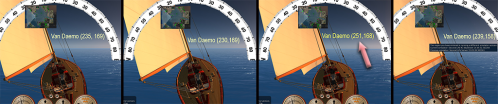
The next picture (on the right) shows a view of the fleet from high above the spectator blimp taken after the fleet made its first tack; all the boats were now on port. On the left of the image yu can see Waypoint leading Eureka, and the right side shows Narwhal far in the distance in front of Second Chance.  NYC is the ‘lowest’ of the four boats as they proceed to the mark.

When he did not win the start, Chaos kept a cool head and took a lesson from WYC’s tactics in Race One. Finding himself  hehind, Chaos deliberately tacked early, sailing away from the pack.   

Look what happened next in the picture below. The first image shows Chaos as he reaches the end of his course  and makes a turn; his new course is a starboard right-of-way tack that crosses directly in front of the rest of the fleet.  Chaos timed it perfectly; the middle image shows Narwhal crossing right in front of All-Star’s path. Massy now had no choice; he pulled up short and came about to starboard.

The lower image is a few moments later. It shows all three boats now sailing on starboard with the orange mark in the distance, two tacks away. WYC looks in the lead, but NYC is sailing windward and closer to the mark. Perhaps more important, in that position Narwhal has the “height” to take tactical control.


Watch what Narwhal does next.

 As you can see in the first image below, since All-Stars was running parallel and ahead of Narwhal but on a lower course, they ran out of water and had to tack back to port again. The problem is that NYC was blocking them, and NYC was still on Starboard with Right-of-Way. Waypoint had plenty of room, but In order to avoid NYC, All-Stars had to fall off and go astern of Narwhal as shown in the middle image.

That extra few seconds and change in course heading proved disastrous for Narwhal’s competition. Remember, Eureka and Second Chance Were on the same heading and only moments behind the lead boats. In response to NYC’s blocking maneuver, All-Stars lost momentum and turned into the path of the oncoming boats, as shown in the middle image. I can imagine Alain and Trapez shouting  a few unrepeatable words as they desperately tried to execute last minute hockey-stop turns. A collision was inevitable however; the WYC, Eureka, and Second Chance teams all broadsided each other and awkwardly sat in place for more than a few moments  as they sorted out locked rigging and disengaged their scraped hulls. 

While all that was going on, Narwhal was out ahead with clean air and an unobstructed racecourse, moving in record time.

The image below shows the NYC team Roaring through Anchor Cove Channel on their way to the final leg of the course. Unfortunately the other three boats continued in close quarters after their pile-up. They stayed overlapped and squabbling  for nearly the entire remainder of the race, losing time in the process.

The lower image below shows them traveling three abreast in Anchor Cove. That must be a tribute to wonderful sailing; I didn’t think it was actually possible to fit three J-Class In that channel overlapped…

The final figure below shows Narwhal working the last leg back to the Raceline, while the other three boats have just raised spinnaker and are still heading to the last waypoint. Narwhal went on to take Race Three’s First Place in record time, finishing a full two minutes ahead of WYC All-Stars, the Runner-Up.

Nice work for a substitute skipper du jour, Chaos!


→ Leave a CommentCategories: 2009 J-Classic · J-Class · Racing · Uncategorized
Tagged: , ,

J-CLASSIC FINALS II: EUREKA!!

November 16, 2009 · 1 Comment

j-CLASSIC FINALS II EUREKA copy

Last time I told you about the first race of the J-CLASSIC Finals. Waypoint had all the moves, and out-sailed the rest of the fleet to an impressive victory, crossing the line a full minute ahead of NYC-Narwhal, the closest competition.

The Finals certainly didn’t end there, however. There were three more races to go!

The Second Race used the same chart as before, and once again all four boats began on starboard tack.

Finals Race Two 01

 As you can see in the images above, at the start Eureka jumped out front and cut the line in the middle to grab a five second lead over NYC-Narwhal. Waypoint All-Stars was right there on Narwhal’s heels, and Second Chance brought up the rear.

Repeating his tactic from Race One, Toraba Magic shifted early from starboard  to a port tack as the boats began to zig-zag their way through Flat Hammock.

Finals Race Two 02

The images above show the advantage this gave WYC when the four boats met up again near the yellow buoy. At that point All-Stars had already gybed and was on starboard when the rest of the fleet was still on port. as in the first race, Narwhal was forced to yield to WYC, losing position.

Finals Race Two 03

Toraba Magic played this pretty flawlessly, and All-Stars was able to block Narwhal a second time just a minute later as the boats tacked in Sugar Reef.

Finals Race Two 04

The first image above shows the position of the four boats as they reached the first mark (Indicated by ”  * ” ). Eureka maintained its lead position And took the turn well ahead of the fleet, followed by WYC. NYC-Narwhal lost considerable momentum dueling with All-Stars, however, and Second Chance had an opportunity to catch up and move inside at the mark. As the four boats began the reach leg, NYC fell into last place.

Eureka - Race Rock

The above image tells the story at the midpoint of the race; Eureka took advantage of the clean air and open water to build  an impressive lead; Alain had already rounded race rock by the time All-Stars entered the sim. NYC crashed during the reach leg, and withdrew from the race, leaving Trapez and Toraba to follow Eureka’s tail back to The Finish.

Finals Race Two 09

The final images above show Eureka taking the turn in Sugar Reef, then falling into a three-sim Run down to Quoddy Head. WYC and Second Chance Can be seen in the far distance; they never got any closer. This race was Alain’s and he held the front position each and every step of the way. What a great job!

So, with two races down and only two remaining, WYC and Eureka each had first place wins; both teams looked pretty good. Second Chance had 3rd and 4th place finishes and would need strong sailing, luck, and probably some black coffee to catch the leaders.

 NYC-Narwhal was also in real trouble at this point, with only a 2nd place finish on the scoreboard, and they had just used up their only “discard” for the regatta… The story of how they came back in Races Three and Four to decisively win the Cup will need to wait till tomorrow!   Finals Race Two 10

→ 1 CommentCategories: Uncategorized

J-CLASSIC FINALS: Toraba, Terrific!

November 13, 2009 · Leave a Comment

OK OK OK, I know I haven’t written very much here recently, but don’t expect any apologies, since I’ve been up to my neck in details with the J-Classic races!  After ten weeks, 120 sailors, 15 teams,  and races that traversed 800 sims… Wow!  Do I have a lot to write about. If you were there for any of J-CLASSIC, you know what I mean.  

 Most sailors already know there were eight major distance races that served as the qualifying events for the J-Classic. Fifteen incredible teams participated, and by the scores and my personal estimation, every single one of those teams proved a champion.  Nonetheless, when the dust settled after eight events, only four teams remained standing. That group of four then advanced to the Final Round in Sailor’s Cove on November 7.

Today let me take a few minutes to share just one of the races from that day; the very first one. However, I promise to keep going over the next few weeks, and cover the whole event (I hope!).

 The Final Four J-Classic Teams (and their final sailing crews) were:

  •  Nantucket Yacht Club — Narwhal:
    Chaos Mandelbrot, Nomad Zamani, Glorfindel Arrow 
  • Waypoint Yacht Club — All-Stars:
    Massy Johin, Toraba Magic, Mikoto Daxter, Steyr Darwin
  •   Eureka:
    Alain Gloster, Suzi Siemens:  
  • Triumphal Yacht Club — Second Chance:
    Trapez Breen, Fiona Haworth 

The Finals consisted of four races that all began in Plum Gut.

The First two races followed a course familiar to many sailors, based on Epicurus Emmon’s old FIYC Hotlaps Chart. Using a wind from due North, the fleet progressed on a beat to the orange mark in Sugar Reef, then fell on a reach to Race Rock. The return path reversed this route, but then continued South to circle a small island in Quoddy Head that allowed an upwind final leg to the Finish.

 J-Classic Finals Chart 101 512Nothing too tricky, you might think, but often the most simple courses like this one end up the most difficult; they provide a true test of fundamental sailing skill and tactics.

Waypoint All-Stars drove this point home in the first race.

The images below show the start of Race One; Narwhal, Eureka, and Second Chance all began on a Starboard close haul tack in single file. With Nomad Zamani at the helm, Narwhal boldly jumped out in front of the pack and set the pace, crossing the tape near the windward end of the race line at 00:00:03. WYC All-Stars, led by Toraba Magic, chose a riskier pre-start tactic; they came at the line on an unobstructed reach from Anchor Cove channel. Luckily, All Stars had plenty of room to do this without barging, and they fell in behind the leader Narwhal with a starting time of 00:00:13. Eureka was next to cross with 00:00:27, and Second Chance brought up the rear at 00:00:42.


So far this looked like a pretty standard race, with a textbook Starboard Start  leading to a upwind beat to the first mark. Conventional sailing dogma says the fastest boat would be the one that now made a series of long tacks with the fewest number of gybes to that first orange mark in Sugar Reef. Narwhal was following the playbook. NYC was in front with a 10 second lead, and given its windward dominant position, there was an excellent chance Narwhal would continue to pull away from the fleet unless it made a mistake. Nomad Zamani was at the helm, however, and everyone watching knew Nomad made precious few mistakes in eight prior J-CLASSIC performances.

 As I watched the race begin, I thought that Narwhal might already have this first race in the bag, right there in Plum Gut…

But I was wrong.

I didn’t know what Toraba Magic had planned! Toraba knew how this race was going to unfold unless he switched tactics and took control.  He wasn’t going to just play Nomad’s follow-the-leader game and settle for the #2 spot in this race.

Toraba defied the usual conventions: he  swung over the helm shortly after crossing the line and took off on a port tack sailing away from the rest of the fleet; All-Stars was laying a trap!


If you look at the picture above, you can see the positions of the four boats a minute later as they continue to tack upwind through Flat Hammock. Narwhal, Eureka and Second Chance are now all on port tack, and Nomad is in control with a clearly dominant windward position relative to the other two boats. If either try to pass NYC, all Nomad has to do is fall a bit off the wind to gain speed and then use the shadow from those huge J-Classic sails to hold the competition in check.

But look again at that top picture above. Toraba isn’t playing that game. Remember All-Stars  tacked early, so although WYC is still  technically behind and lower than Narwhal, they have already gybed. Toraba has Starboard Right-Of-Way and NYC is in his crosshairs. Nomad could see the set up also; he was forced to gybe Narwhal early and yield position to All-Stars.

Look at the second picture above, after NYC and Eureka both came about. With Toraba’s one maneuver and in a very short amount of time, the WYC team snatched the lead away. Woots! Nice sailing, ALL-STARS!!!

Once Toraba was in the driver’s seat, he played it to advantage and continued to eat Narwhal’s lunch. As you can see in the top frame below, Nomad was skillfully fighting back as the fleet of four tacked across the southern half of Sugar Reef. Narwhal gained at least two boat lengths in that short distance, coming into overlap with the WYC boat, but Toraba successfully fended Nomad off with windshadow. As shown in the second picture below, all three lead boats ran out of water on that tack before Narwhal had any hope of challenging WYC’s juggernaut.

Toraba then skillfully flipped to port tack, threw another blanket on Narwhal (just to be sure), and then turned his eyes on the first mark, just a short jump ahead. All-Stars then never looked back; they plugged into overdrive and thirty seconds later they ‘poof’ disppeared from my screen, out of view range.J-CLASSIC Finals Race One - 04 Narwhal, Eureka, and Second Chance were, however, still closely positioned and approaching that first mark. Eureka ended up overlapped with Narwhal as they came to the turn, as shown below. There was no protest, and I have not discussed it with any of the skippers, but I think it would be an interesting discussion about who had Right-Of-Way and which rules applied in this next sequence.

 As shown below Narwhal was high enough to reach the first mark on port tack by ’pinching’ to windward. If you look behind NYC in the first picture, you can see Trapez Breen sailing TrYC on an optimum port tack - close haul heading; by comparison Narwhal is sheeted too tightly by intention, trying to scrape  past the mark without needing to make an extra time-wasting turn.

There is one problem with this plan … Eureka.

Alain Gloster (Eureka’s  skipper)  had not needed to fight All-Stars, so he was still fresh, focused, and well-rested ( :-) (although I admit it was 3:00AM for Alain).   Eureka was able to make the extra, short turn  it needed to approach the orange mark correctly on a starboard tack. The pictures below suggest Alain ended up “in the zone,” inside NYC  and on Starboard tack, with Narwhal on Port. I only had one vantage point, so I can’t say for certain what the ruling would have been here, but I admit that the judges were watching and had a quick cross-check when this occurred to find out if there were protests or if skippers had calls for room that might not have registered on our chat screens.

There were no such protests, and Narwhal grabbed the opportunity to secure the #2 spot by turning ahead of Eureka .

J-CLASSIC Finals Race One - 05 

 The image below shows the lineup after the remaining three boats passed the mark and set an outbound reach course towards Race Rock: The order was 2-Narwhal, 3-Eureka, and 4-Second Chance!

 WYC was so far out front  in that image it was no longer in draw range. A few moments later, however, the WYC All-Stars emerged from the mist over the northern Sailor’s Cove waterways as it steamed back full throttle on the return course. 


J-CLASSIC Finals Race One - 07

With incredible speed, spinnaker a-fly, and zero competition anywhere within two sims, Waypoint had time to flaunt it; they did a show-off runway strut downwind past the overflow crowds waiting by the Finish Line. As the last image above shows, Toraba then cut the line a full two tacks and one minute ahead of NYC and Eureka. It was a remarkable victory lead for a boat, a team, and a skipper.

Recently I’ve been reading opinion posts by people (generally non-racers) who complain that SL Sailing is an ill-equipped, poorly suited game that can’t possibly match our goals to emulate the challenges of Real-Life sail racing. There are many facets to that question, I know, but after watching this first Finals race, I was pretty comfortable I knew my answer to these nay-sayers.  What I saw  in the above race was the real thing;  full of strategy, intelligence, and down-out plain ‘guts.’ That’s real sailing, and if you don’t think so… 

Go talk to Toraba and TEAM WAYPOINT !!!!!!       

The Finals had three more races, and Eureka, Second Chance, and Narwhal all had moments to strut-their-stuff and show why they deserved a slot in the J-Classic Final Four! Narwhal finally pulled off the untimate victory with an incredible tour de force display of talent and determination…

but it’s late, and if you want to hear how it all turned out, you’ll have to “tune-in next time, kids…” 

→ Leave a CommentCategories: 2009 J-Classic · J-Class · Racing · Uncategorized

Interview with Hay ah

October 5, 2009 · 1 Comment

Interview with Hay Ah

by Liv Leigh

Imagine an avatar with a wild, wild haircut, imagine complex calculations. Imagine someone with a passion for mathematics who tries to solve the big questions of our little virtual universe. There’s a name that goes with this picture and it’s not ‘Albert’… Liv Leigh interviewed Hay Ah, the startline lady. A story about the ongoing battle against lag, about new features to come. A story about beach, Beach Cats and how Bittersweet Lime may have saved the J-Classic’s port-to-port races.

“I never knew about lag before I started scripting the racelines, I was innocent and happy.”


Liv Leigh: Most of us know you as the startline woman… But there must be a way you got into sailing and into scripting for it. How did it start?
Hay Ah: Well, I wanted to start scripting immediately when I was in sl, but it was way too hard for a newbee scripter to start.
Hay Ah: So I ended up partying and shopping for 3 months.
Hay Ah: Later i started with changing little scripts and eventually progressed.
Liv Leigh: I see, do you have a background in RL programming?
Hay Ah: Not really, I liked mathemathics in school, those problems were like puzzles to me.
Hay Ah: I knew how to edit some php scripts and java but that was it.
Hay Ah: I learnt everything from the lsl wiki.
Liv Leigh: That’s pretty impressive, considering the impact your items have made in the community so far. Especially in the relatively short period you’ve been providing them. Why did you choose for sailing as a platform to script for?
Hay Ah: Well, I was present in the sailing community since about summer ‘08. I always liked beach living. I liked the openness of the community and off course I liked learn to sail in SL.
Hay Ah: After I had the possibility to buy land in the Sailors Cove sims I met Epicurus Emmons and he asked me if I maybe would like to write a startline.
Hay Ah: That was last februari.
Liv Leigh: Ahh.. and you had never done such a thing before?
Hay Ah: No, this was far more complex and difficult then I had ever imagined.
Hay Ah: I learnt scripting while doing it.
Hay Ah: Lots of testing off course, trial and error.
Liv Leigh: I bet..
Hay Ah: But i can surely say this is the most complex set of scripts i have ever wrote, learnt a lot from it too, especially about lag issues.
Liv Leigh: And I guess the work is not over yet?
Hay Ah: Haha. I thought I was ready at a certain point, yes, I truly believed that, but there are so many ideas to put in.
Liv Leigh: We know you are now one of 2 persons to have developed a networked line, which offers us the chance to do port-to-port races. This dream is well over 18 months old in SL, if not longer. I remember I heard Owen Oyen was working on one a long long time ago.
Hay Ah: Oh really? I didnt know that, I only knew of Cynthia and Yuu + Mothgirl.
Liv Leigh: I remember Joepie Korobase and I had been dreaming on it over a year ago. Mothgirl or Joepie told me this.
Hay Ah: Yeah, I spoke with Joepie too, she made me think about making a networked raceline.
Liv Leigh: Oh lol.. So I guess there are some people who do exercise influence on development in the background.
Hay Ah: Yes, Epi always had contacts everywhere across SL and he introduced me to a lot of people. Joepie had some very bright ideas about the lines, she wanted to set up a central server wich would connect all the lines.
Liv Leigh: That sounds a bit like Owen’s system for calculating currents. How is your line done now?
Hay Ah: Well, you can wear a special network HUD and you can assign the raceline to the role of start or finish line.
Hay Ah: You have to go to the sim the startline is in. When this is set as a startline, you will have to go to the other sim with your designated finish line.
Liv Leigh:That sounds not too hard.
Hay Ah: When they are both set, you just start the startline by the push of a button and its synced to the finish line. All data of the owner and the time will go to the finishline by email.
Hay Ah: Its really simple, I think.
Hay Ah: Point is, it had to be very easy to set up, and there couldnt be any problems like servers not being accesable.

Epi, Jane, and Hay doing their best to break Hay's first raceline in May 2009

Epi, Jane and Hay even dropped steel plates on it. The line didn't break!

Liv Leigh: Great.. What do you think the impact is that this system will have on sailing, apart from making the J-classic possible?
Hay Ah: I think SL sailing will never be the same.
Hay Ah: It’s just fun to not be bound to one place and feel free how to plot your own race in a way.
Liv Leigh: I agree, I also think it will offer us a lot of new course options within smaller areas even.
Hay Ah: Yeah, there can be made very peculiar races with a small setup.

Liv Leigh: Now about something else.. You do sail yourself. What boats do you use most?
Hay Ah: Oh!
Hay Ah: I love the Trudeau Beach Cat the most. :D It’s so much fun sailing that ship and it’s very, very fast.
Liv Leigh: A notorious speed monster!
Hay Ah: Yeah, it really is, and it’s not script heavy. But the features in the cat are a bit outdated, there is no windshadow or so.
Liv Leigh: Yes, it’s a pity it’s not being raced as much anymore lately.
Hay Ah: Sometimes I see someone sailing it. I believe Julia Ceres hold races with the cat sometimes.
Liv Leigh: Yes, one of it’s bigger fans you mentioned there
Hay Ah: Yeah, she is a speedmonster herself too.
Liv Leigh: LOL
Hay Ah: She is the only one I knew when I first entered the sailing sims.
Hay Ah: I met her way back in Violet Welcome Center in our newbee fase.

Liv Leigh: You mentioned your first 3 months in SL: Partying and shopping. Apart from that I think most of us have some places locked into our hearts from those beginning periods. What would be your favourite spots? and maybe one of the old spots is till amongst them?
Hay Ah: Ohh, that’s very difficult to say, I love to explore a lot through SL. If I have spare time, that’s what i do most.
Hay Ah: I love the XYZ sim a lot, very special art and structures there and no way of re-making them. :)
Hay Ah: I love to see spacy sculpty sims with abstract unknown objects, like Xeniversity.
Liv Leigh: I see.. I saw some in your profile. Also every pic had it’s quotes attached to them.
Hay Ah: Yeah, the quotes ^ ^ I love them. :)
Hay Ah: I am in a group called keep moving and they have a quote of the day always…..I just pick out the ones I love most for a certain event….
Hay Ah: “Happiness is a butterfly, which, when pursued, is always just beyond your grasp, but which, if you sit down quietly, may alight upon you.”

- Nathaniel Hawthorne

Liv Leigh: You mentioned ‘lag’ before. The evil monster that lives in the depth of our seas and all sailors are scared of. Could you maybe, as scripter, tell us a little more what is meant with lag, and what versions we have?
Hay Ah: Oh dear, lag is pure evil.
Hay Ah: I never knew about lag before I started scripting the racelines, I was innocent and happy ^ ^
Hay Ah: But then my scripts didn’t react to my commands, they suddenly delayed when there where more and more boats present at the startline.
Hay Ah: Oh my, I have had nightmares of lag since then.
Liv Leigh: :)
Hay Ah: You can see it as the queing of printjobs. When an event has started in a script like the colission with the raceline, it will get delayed and queued.
Hay Ah: And thats not all.
Hay Ah: If that was it, it would be okay, but a sim has to process alot of events during one second, and if it is too many then it will be simply queued. :D As a result the commands given by the start line scripts won’t be able to start in time.
Hay Ah: It was very hard to find out how I should proceed at that point.
Liv Leigh: I bet. I think I would log off by then :)
Hay Ah: I tested it, changed a bit, tested it again and again and again, until I found the best combination of internal script communication and less delayed calculations. Bittersweet Lime helped me out on the point I was about to quit it.
Hay Ah: She explained how lag worked and helped me to form ideas I needed to solve the problems.
Hay Ah: Most of my scripting time went into testing how I could avoid lag, or better said deal with lag. I designed my line around it.
Liv Leigh: And now.. You have learnt a lot about it.. and helped revolutionise the lines.
Hay Ah: Yeah ^ ^ I feel great about it. :)
Hay Ah: I always wanted to do something for the sailing community, this has been my chance.

2009 J-CLASSIC ROUND THREE (Courtesy of Dil Spitz)

2009 J-CLASSIC ROUND THREE (Courtesy of Dil Spitz)

Liv Leigh: What would be the next steps? Ideas for the future etc.
Hay Ah: Well, the next big thing for me would be handicap scoring.
Hay Ah: That means that different types of boats can start side by side and when finished, every boat of a certain type would get an adjusted time accordingly to their handicap rating.
Hay Ah: Cynthia Centaur has a raceline in madaket wich usues handicap scoring and offered to help me with it, it would be great for future races when it doesnt matter in what boat you start.
Liv Leigh: Yes, it would help a lot of us who sometimes miss races for their favourite boat in the program.
Hay Ah: Also I have an idea to make a score board and a line that will give out the time standings inbetween a race.
Hay Ah: Yuu and Mothgirl are testing http communication with the racelines and I want to test it for myself too. I just hope there wont be too many sailors located in one sim in the very near future.

Liv Leigh: Could you maybe as a last thing answer my regular standard question? What would you, with your background in the SL Sailing world, advice newbee sailors?
Hay Ah: Ghihi…
Liv Leigh: :P
Hay Ah: My advice would be to just have fun in every aspect while sailing.
Hay Ah: Then everything will be going automatically, it won’t be hard, but just very nice.
Liv Leigh: That’s great, thanks a lot for the interview!
Hay Ah: Thank you Liv. ;)

Wolem Wobbitt cuts Hay's line in Spoondrift 

→ 1 CommentCategories: Uncategorized

Blue Mars Open Beta

September 16, 2009 · 22 Comments

blue mars
Blue Mars is a new, three-dimensional online world with an ambitious agenda to build a diverse, global community.
The developers tout Blue Mars as a ‘next generation’ 3-D environment, one supposedly unfettered by the legacy limitations of earlier efforts… (presumably meaning Second Life). I’m writing about Blue Mars today because they recently went to “Open Beta,” so you may want to go take a look.
Here’s one of the promo videos:
 
The sign-up is free, but (cough) the installation package is over 1 GB.  I also had to wait several days before my “application” was approved, and  it was  more than a little irritating  jumping through all the hoops to set up  my beta account.
Having said that, I admit it:  Blue Mars graphics are very pretty… and actually it was easier and quicker getting approved at Blue Mars than it is to SLSailing.org.  On the other hand, I guess, once you are “in” to Blue Mars, it’s pretty obvious this is still an early beta; the  resources and user development tools are largely nonexistent at the moment!

 But if you sign up, you’ll find out that Mars DOES indeed have water! 
Here is a screenshot from one of the (very few) regions currently open:

water on mars

 I’ve only spent a few hours on Mars today, mostly getting my bearings and looking around. It certainly looks as though there’s a potential to develop a multifaceted sailing community there. It doesn’t look like it’s presently on their agenda, however. If sailing develops there, it’s going to take a rich, cooperative interaction between Blue Mars and the large group of fantastic, creative developers and single users from the sailing community.

As soon as I wrote that sentence, however, I admit I smiled… I asked myself “Which sailing community?”

RL Sailors?
SL Sailors?
The ‘best and the brightest’ who are all now on OSG?

Grin. The answer was obvious… there is no difference. We all are sailors, and a new grid is just one more challenge, a new horizon waiting to be conquered.

Until then, I’ll be at the Royal Aloha Golf Club

But Jacqueline? Moth? Alan? Caf? Everybody?
I HATE GOLF.
Let’s see if this place can SAIL!

blue mars golf 700

→ 22 CommentsCategories: Uncategorized

2009 J-Classic: ROUND TWO

September 4, 2009 · 1 Comment

J-Classic Round two 800

→ 1 CommentCategories: Uncategorized

Sheets to the Wind

September 4, 2009 · 5 Comments

sheets to the wind

by Ed Kegel and Moontears Vought

Greetings all! I’m fresh from Blake Sea, sunburned, wind burned, fed up with crashes (stopped counting after the first dozen) and worn out, but satisfied. I now understand her. No, not my girl friend, my J-Class.  Having just completed something I’ve wanted to do from the day I got her………. Sea Trials. And if you think this is a long note, well… it was a long day!

Sugar Reef

Sugar Reef

Have you ever wondered how she behaves under different sheet conditions? How close do I need to trim, for best performance? To reef or not reef, that is the question. And does she take after her distant cousin the Tako in regards to the Spinnaker angles, or does she have her own special needs? Just like a woman, she is complex, finicky at times, can be a real bitch,  but in the end – A JOY TO RIDE.

Many thanks to Moontears Vought, who helped me with this endeaver both with sailing back and forth on the Blake Sea add nauseum, and for being a great sounding board. Her thoughts are always sound and worth investigating. I would also like to thank the numerous other people who’s articles contributed to my understand of sailing in SL. Last but not least thank you Jane Fossett and JoyofRLC Acker, for helping to spread the wealth of information available in various forums and sources about this boat and sailing in general in SL.

OK, enough accolades; lets get to the results. I don’t purport to be a nautical expert, nor a marine engineer. But I do know how to conduct an experiment, limit changes to one variable as much as possible here in SL, and read the data. The conclusions I draw, while they may be up for debate by some, like the physicians debated a person’s illness in Moliere’s time. I am satisfied from the emperical, experimental evidence that I am on sound ground with my  conclusions and will sail her based on that understanding.

QUESTION:
1. Moon and I wanted to find out if under a steady wind the boat exhibited any “sweet spots” or preferences in sail angles using the Jib and main sheets.

CONDITIONS:
Venue was the open expanse of Blake Sea. Setting up our own wind at 12m/sec with no variations in speed or angle, we began trying various sail trims. To start we left the main in “Reef 0″ condition. Moon was skippering, and I was aboard on the hatchway, centered and did not correct for heel. We took readings of AWA, sheet angles, and boat speed from the INFO HUD. Boat helm was adjusted via the left/right keyboard arrow keys, and sheet trim was made via chat commands imbedded in gestures linked to F-Keys.

CONCLUSIONS:
A. The Jib and main sheets appear to like the same angle setting at least as far as the sea conditons allowed us to tell. Any mismatch beyond a degree cause a fall off in speed at all angles of wind, sail, and speed we tried.

B. For best speed at whatever heading, the boat wants constant correction of both helm and sail angle. Even with steady wind, to squeeze the last tenths of speed out of her you need to be sailing her every second. And given the variability of race winds, changing direction slightly all the time, its essential to keep adjusting the helm and trimming sails in and out by a degree or two. The AWA is constantly changing.

C. Sail angle adjustment by single degrees is critical for best speed. Yes you can set and cruise for a leasurly sail but again we were looking for every last tenth of a meter per second.

D. Color of sails doesn’t matter, LOL.

E. After repeated trials the optimum sail angle is 50% of the AWA (Apparent Wind Angle) below or above 50%  cause a speed drop off. The following data was typical for various angles.

DATA:
AWA,  sheet angle jib & main,  m/sec boat achieved

050,  027,   7.1
050,  026,   7.2
050,  025,   7.4
050,  024,   7.3
050,  023,   6.8

As soon as you get two or more degrees away from 50% speed really starts falling off. So need to trim constantly via helm and sail.

F. Three (3) sweet spots stood out to us.
AWA 34 degrees both sails set to 17 degrees, speed 4.0m/sec.
AWA 46 degrees both sails set to 23 degrees, speed 6.9m/sec.
AWA 66 degrees both sails set to 33 degrees, speed 10.0m/sec.
Either due to a stepped perforemance level indicated by a change in slope of the graphed points or the highest speed achieved overall with a speed fall off either side of that angle combination. Data is as follows:

DATA:
round one EK 01AWA,  sheet angle jib & main,  m/sec boat achieved

030,  015,  2.0
032,  017,  2.6
034,  017,  4.0    Close haul sweet spot
040,  020,  4.4
042,  021,   5.3
044,  022,   6.1
045,  023,   6.3
046,  023,   6.9    Next slight Plateau
048,  024,   7.2
050,  025,   7.4
060,  030,   9.4
064,  032,   9.9
066,  033,   10.0   Best performance
068,  034,   9.9
070,   035,   9.7
080,  040,   8.9
090,  045,   8.1
100,  050,   7.5
110,  055,   6.9
120,  060,   6.3
130,  065,   5.8
140,  070,   5.3
150,  075,   4.9
160,  080.   4.4
170,  085,   3.7
170,  090,   3.6
170,  090,   2.5   wing on wing
179,  090,   1.7   wing on wing

Ok that should be enough on question one.

J-Classic Round One 04

QUESTION:
2. How does heel affect speed and what is the relationship between reefing to correct heel and crew movement to rail to correct heel? (We observed that in the first race with two crew, reefing the main slowed us down. Yet, when sailing with just skipper reefing mainsail on close hauls it really improved speed.)

A. Tryin it out with various crew showed that the benefits of reducing heel occur with either reefing or crew movement.  It also depends on wind speed. In the first race two crew with a 10 m/sec wind was enough to reduce heel. Adding the reef as well caused a decrease in speed because of reduced sail area. The crew was sufficient to bring heel below the level it reduced speed. With only one crew and a 12m/sec wind speed there was still too much heel, and therefore reefing leveled out the boat more and increased the speed.  Bottom line: try reefing; if speed increases, use it. If not, don’t.

DATA:
ed kegel 03For one (1) crew member in addition to skipper riding rails properly with 12m/sec wind.
AWA,  sheet angle jib & main,  reef state,  m/sec boat achieved

066,  033,   reef 0,     9.7
066,  033,   reef 1,  10.6

046,  023,   reef 0,     5.1
046,  023,   reef 1,   13.7

034,  017,   reef 0,     5.0
034,  017,   reef 1,     7.3

QUESTION:
3. Trimming the Spinnaker seems more dificult, what are the best trim angles? The Tako Spin has best results trimming to AWA – 90. IS this the same in the J-Class? Example would be AWA is 150 so in Tako trim main to 75 and spinnaker to 60 for best speed.
 Does wing on wing work for the spinnaker and main? Is using the spinnaker alone a good idea?

CONCLUSIONS:
A. Under no conditions were we able to show the Spinnaker alone worked well. Always use the main as well.

B. The J-Class gets best speed when Spinnaker and Main sail are both trimmed the same, to half the AWA. In the above example AWA of 150 requires both sails trimmed to 75 for best speed. Just like with the Jib and main combination being within one (1) degree of 50% of AWA gets you the fastest result. The luffing of the spinnaker stops when you are within ten (10) degrees of the 50% mark. But stopping the luffing does not get you to the best speed. for that you need to trim to 50% of AWA.

C. Wing on wing does not work well with the Spinnaker.  with 12m/sec steady wind dead astern, wing on wing only gave 1.7m/sec boat speed. In fact the best speeds are obtained when the wind is not at 179 degrees (directly aft). Having a few degrees off center gives the best speed. You will need to tack the Spinnker and main to the correct side. The confusing part is the Spinnaker boom goes on opposite side of the main boom. This looks strange after seeing the jib boom on the same side as the main boom.

Jaspar and Ed

WRONG RACE WINDS
A note of warning about race wind and not finishing a race. The boat will retain the last race wind and not reset to the new wind if you crashed and did not cross the finish line on a previous race. You can prevent this situation by discarding the boat, (delete it) instead of taking back to inventory. You have the Master boat in inventory , always rez that one, and never a previous boat uses before.

Another simple solution would be, before a race, all boats should do a practice run. The boats cross the start line, sail for at least one minute, then return and get a FINISH time. That would ensure all racing boats are listening to the windsetter and using the right wind.

HOW DOES THE WIND WORK?
Found this link in one of Jane’s posts. Its especially helpful in understanding the variability of direction and speed that the race winds we are using have. Basically it means that at one point when you practice you might make a close haul by an island or bouy, yet the next practice or on race day, not make that same path successfully. It’s due to the variability of direction and intensity of the winds.

http://slsailing.com/archives/220

Hope all this helps you sail better and faster,
Moon & Ed

Ed Kegel dueling Jaspar Recreant in Round One

Ed Kegel dueling Jaspar Recreant in Round One

 
                                                                                (¯`v´¯)      
                                                           *:-.,_,.-:*’´ `*.¸.*´`’*:-.,_,.-:*

→ 5 CommentsCategories: Uncategorized

J-Class Numbers

September 2, 2009 · 2 Comments

J-Class numbers

Numerology

Since the J-Classic Regatta Series is warming up, I went hunting through old files and spreadsheets I have on  J-Class, trying to see if I had any performance data that I hadn’t gotten around to post yet.

multi trudeau

The image above is fairly old, but I think it’s still accurate. The chart that compares the performance of the J-Class without a spinnaker to the Trudeau Twenty, the Knockabout, and the Leetlecat. When wind= 5.0m/s, you can see the major difference between the boats occurs predominantly on upwind performance. Using just main and jib over 100° apparent, all four boats are pretty similar.

I also threw in the knockabout performance data with winged sails over 130° (shown in pink). Winging the sails enhances performance over 140 degrees in knockabout and T20. There is no performance boost in the J-Class, however. (C’mon… that’s why you have a spinnaker).

ez-hud-main-spin

 Here is another, fairly similar example of performance With different sails.
The blue line in the above chart shows the Speed Over Ground for the J-Class Using the EZ-HUD that comes with the boat. That’s a quick way to get the ‘manufacturer’s recommended’ sail settings. I then plotted the boat speed at different angles using  just the mainsail or just the spinnaker. Those results are shown in green and red above.
 The chart showsthat with 5.0 m/s wind, the spinnaker becomes effective with apprent wind angle >90°, and the spinnaker boost effect is rather substantial over a broad downwind range, falling off quickly over 170.

  polar-2

The image above is a polar plot showing similar data for the EZ-HUD, mainsail, and spinnaker. The shape of the spinnaker curve is a close match for the RL parachute.

11-and-5mps-plus-reefing

The next chart (shown above) shows a similar graph, but in this case 11.0 m/s  wind is compared with 5.0 m/s. With both wind speeds, there is a big jump in performance (i.e., boat speed) when the boat fall off to 40° apparent. 
This graph also shows the benefits of reefing. The green line shows Speed Over Ground at 11 m/s without reefing, and the blue line adds the reef point. There is a rather explosive increase in speed when the mainsail is reefed while heading windward between 30-60° apparent, and around 40 degrees the reef will more than double boat speed.

Don’t count on it too much, however. Under these conditions, at 60° apparent or greater, there is little, if any noticeable benefit.

 11-and-5mps-plus-reefing-polar1The above chart shows the same data in a radial plot, this time with the “reefing boost” indicated in pink. 

reefing J-class

 This next chart was an attempt to show the correct apparent wind intensity for the reefing effect. The boat heading was held constant at 40 degrees apparent, and the boat wind was gradually increased. Apparent wind readings were then correlated with boat speed under reefed and unreefed conditions.

At low-wind intensities, the boat responds best to unreefed sails (as shown in the blue curve above). That effect plateaus over approximately 11 m/s apparent. However, the curve for reefed sails continues to sharply rise along with wind intensity, and the crossover point (point where reefing starts to boost speed) is around 11 m/s (at least for the single heading of 40).


hike-position

Here is a final bar graph showing the effect of hiking with a single crew member. On a fixed heading of 40 apparent with Real Wind= 5.0 m/s, there is roughly a 15% speed difference when the crewperson shifts from the leeward rail to windward. I don’t have the numbers for a full crew yet!

J-Class numbers 2

→ 2 CommentsCategories: Department of Public Works · Trudeau Yachts · Uncategorized

Getting over it

September 2, 2009 · 4 Comments

A Good Start copy
The 2009 J-Classic Regatta Series got off to a wonderful start this past weekend, with a truly fantastic series of first round races.
Since the teams include a number of crewmembers who are racing for the first time, and since we have eight more events  to go in the regatta series, I thought it might be  a good idea to spend a few minutes talking about basic race topics that will probably come up in the rounds ahead. The J-Classic fleet is full of wonderful, racing-savvy sailors who already know most of what I’m going to say better than I do… so I’d ask them to please feel free to post their comments, fill in what I forgot, and add their ideas and opinions on these and any other topics.
I wanted to begin by talking about about Race Starts.  In real life as well as in SL, getting a good start is often critical to a winning  a race.  The first boat that crosses the line on their intended course without fouling gains as a huge advantage, with open water and clean air.  Since there are no other boats around to cramp their style, the first boat over the line can set its own course and run the race just as the crew practiced it. The lead boat is the ‘alpha dog’ at the head of the pack, and its a huge advantage.
 
So? How do you get a good start? Here’s one simple strategy from Real Life.
“If you win the start, you can win the race.”
When the countdown starts, all boats raise sail and begin to jockey for position and build up momentum.
The prestart is easily the most crowded part of a race, and the Right-Of-Way Rules become critically important.
They often determine who captures the lead.
Rule 10 is:
 
10. Starboard Rights: Starboard boats have Right-Of-Way over Port Tack Boats
Under Rule 10 most skippers choose to start a race by crossing the line on a Starboard tack, since any boat on Port will need to give way.

The image below from this morning demonstrates this well; the entire Waypont fleet crossed the line on a similar starboard course.

Waypoint starts starboard
But if everyone is on a Starboard tack, you need another trick up your sleeve to get a startline advantage.  Most sailors go with Rule 11:
11. Leeward Rights: Leeward boats have Right-of-Way over Windward Boats
All the crews are vying to cross the line at the same moment, when the countdown hits zero
If you are the leeward boat during that countdown, all the others need to get out of your way. You not only get red carpet treatment; everyone else loses momentum trying to avoid you. It’s even better when you have several boats parallel and overlapped about to cross the line. If you’re the leeward boat, all you need to do is yell “LEEWARD!!!”  or “UP UP UP.” That forces the boat  adjacent to you  to turn into the wind, and often causes a domino effect. All the other boats upwind of them suddenly are forced to turn as well, while you stay on course and wave “bye.”
So: The strategy you want is one that puts you on a starboard tack and  positions you as the leeward boat as you hit the raceline a moment after it turns green.
There are two more nuances…
Most race lines are perpendicular to the wind, so it may not seem to make much difference which point of the line you cross. Well, take a look at Waypoint above… and pictures of any other expert race fleet. They are all starting from the end of the line at the windward buoy. That position gives them the longest  first tack moving toward the windward mark. They all know the boat that makes the fewest tacks while maintaining momentum often leads at the Finish. Those gybes along the way aren’t free; you pay for them in time and momentum. 
There is another thing about that windward raceline buoy, however.
 Take a look at the two pictures below from NYC Sunday Big-Boats a few days ago.  LDeWell Hawker was steaming in on a Starboard tack, aiming to slice the line at 00:00 sec on the far windward edge near the green buoy.  Gemma Vuckovic was also ready, though… a few moments before the top picture, she suddenlycame about, expertly falling into a parallel and overlapped position, just leeward and a fraction of a second ahead of Hawk. The lower image below shows them crossing together, close enough to whisper sailing complements to each other.
If this race were “serious,” however, Hawk knows that Gemma might not be quite so polite! As I mentioned above, the leeward boat has ROW. Gemma could call “UP UP UP”  and force Hawk to turn windward.  Doing so would most probably slam him into that innocent little green buoy at the line’s end.
Hawk’s a pretty great sailor, and he sees this strategy too; Gemma made her point that night. Enough said!
Gemma and Hawk off to a good start.

Gemma and Hawk off to a good start.NYC Big-Boat Race AUG 30

(Note: the start buoys are not considered obstructions or race marks under the Rules. You can’t ask for “Room!” under Rule 19, and sorry… Rule 18 doesn’t apply either. So if Gemma pushes you into a racline buoy next week, dont complain (grin) — it’s your own fault!) 
OK– A good, standard start then means: You do a Starboard tack, nose into the far Lee position, and point your bow at the Windward end of the line…
  
But just one more thing: After the Start, use your advantage to move into the Windward slot with respect to the rest of the fleet.You needed Leeward rights to control your start position while milling with the fleet in the countdown. Once you cross the line, however, your priorities change a bit; it’s Showtime.  Now you need to stay Windward of the fleet. In that location you can shadow any pretentious competition that tries to creep up on you, and you can defend your lead. After all, on an upwind beat, the windward boat can always speed up by falling slightly off the wind. The attacking leeward boat isnt so lucky; it needs to point higher to pass and it will lose momentum in that process. Even worse, the leeward passing boat has to get by the lead boat’s shadow. It’s not a easy task (grin).
Some of you may wonder if skippers actually use these tactics effectively in SL…
Grin. Maybe not as often as they should! But in the 2007 Tako Cup semifinals and finals, a number of excellent real life and SL skippers paired off, and used the Start Rules to great effect. They were so good and so relentless dueling for leeward advantage that a set of optional pre-start rules were introduced into the competition to make prestarts fair. The Rule changes were exactlywhat happens in real life as well to deal with this situation and it was pretty humorous … and quite amazing… to see it happen in SL. 
I know most sailors in SL and RL are pretty familiar with the strategy I discussed above. I also know it doesn’t apply in all cases, and a skipper being inventive and adaptive, using unconventional strategies in new situations is often important too. 
However, as in chess, choosing  an unconventional opening move can often prove pretty risky…
 
 On Monday Aug 31, for example, we did a practice run on the Round Two – Fruit Islands Racecourse. A gaggle of great skippers showed up to limber their muscles and stretch their wings across the course as part of their J-Classic practice. If anyone was contemplating some unusual tactics or was interested in testing a novel start, the Monday race was a good place to try it.
As you can see in the figure below, Oh boy did they try it. Despite a crowded pack of very smart, experienced skippers that would likely reach the start line at the same time together, separated by mere inches …
Two boats in the fleet attempted Port starts
Fruit Islands Big-Boat Race AUG 31

Fruit Islands Big-Boat Race AUG 31

 
As you can see in the second image, The Port start boats came within angstroms of  colliding with a wall of spar-and-canvas from the Starboard ROW boats.
Several of us gasped in horror and apprehension.
Of course, however, the fleet  are all pretty wonderful; they have considerable adaptive resources and were able to steer away, side-stepping catastrophe. Once the collisions were avoided, everyone had a good laugh over the audacity of the Ports starts, and the fleet barely missed a beat while turning away to  confront the real challenge: the J-Classic Fruit Islands course! 
It was pretty funny to watch it on Monday play out… but let me tell you, I’m bring ear plugs for Saturday. A Port start like that on Staturday’s Round 2 race will evoke a chorus of protests that could cause inner ear damage!
helm
____________________
 

→ 4 CommentsCategories: Uncategorized